

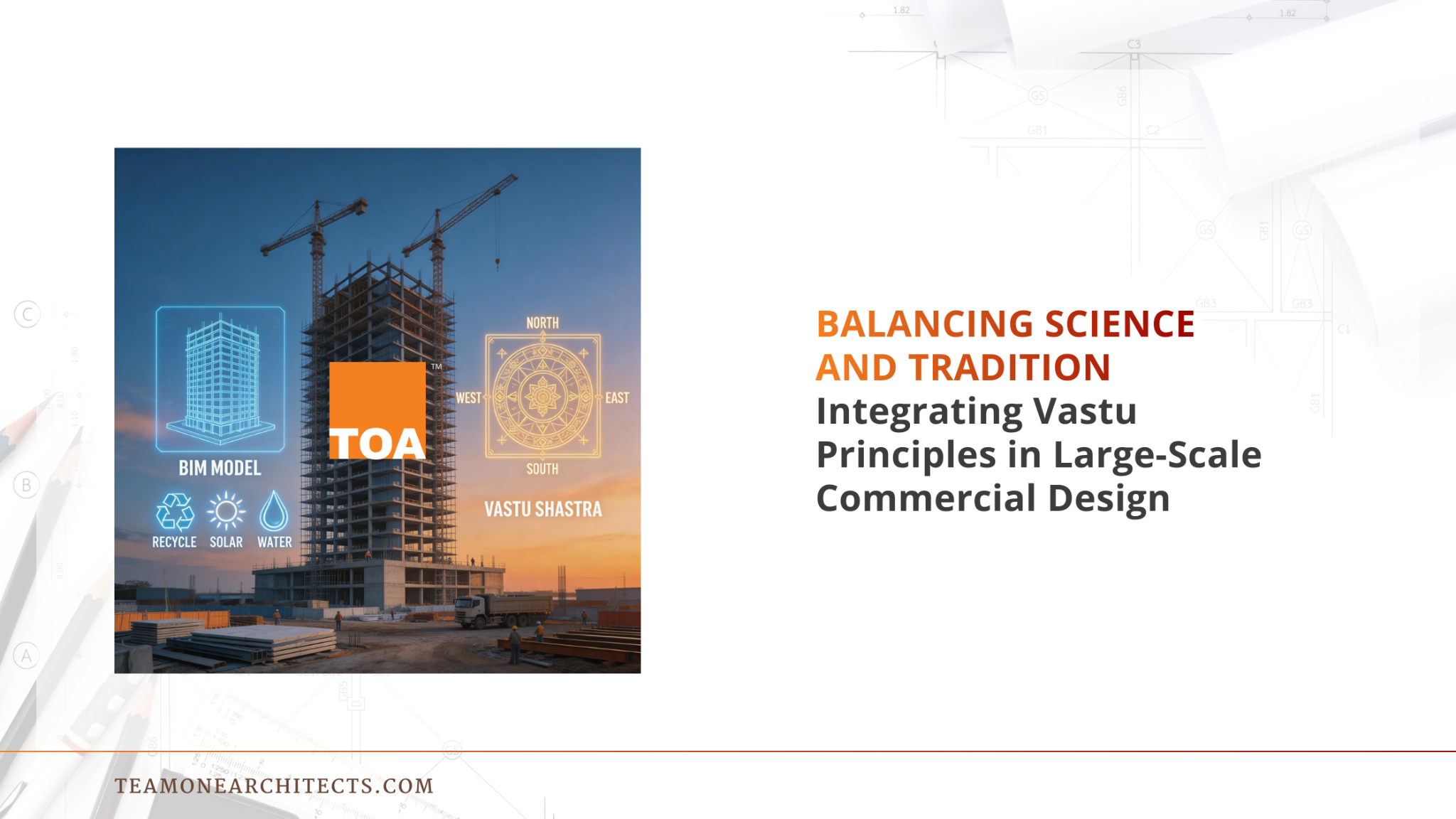
Balancing Science and Tradition: Integrating Vastu Principles in Large-Scale Commercial Design
India’s commercial construction sector is undergoing a quiet but consequential transformation. Alongside BIM modelling, IoT-enabled building management, and net-zero mandates, a growing number of corporate clients — from multinational technology companies to domestic conglomerates — are asking their architects one question that would have surprised the industry a decade ago: Can you integrate Vastu Shastra into this building?
This is no longer a fringe request. Across corporate office campuses, GCC headquarters, data centers, healthcare institutions, and industrial facilities, Vastu Shastra is re-entering the architectural brief — not as superstition, but as a structured spatial philosophy with measurable overlaps with contemporary evidence-based design. For architects in Mumbai, architectural firms in Bangalore, and architects in Hyderabad, the ability to navigate this integration thoughtfully — without compromising structural performance, programmatic efficiency, or green building compliance — is fast becoming a differentiating competency.
This article examines how Vastu principles can be reconciled with the demands of large-scale commercial architecture, why the integration is gaining traction among India’s most sophisticated corporate occupiers, and how design teams can operationalise Vastu without diluting technical rigour.
What Vastu Shastra Actually Prescribes — and Why It Matters at Scale
Vastu Shastra is a Sanskrit corpus of architectural science codified between approximately 6,000 BCE and 1,000 CE, drawing from Vedic texts including the Manasara, Mayamata, and Brihat Samhita.¹ Its core framework organises built space around eight cardinal and intercardinal directions (the Ashtadisha), a central sacred zone (the Brahmasthan), and the five classical elements (Panchabhutas): earth, water, fire, air, and space. Rooms, structural masses, water bodies, entrances, and service cores are each assigned directional zones according to their energetic and elemental correspondences.
At the scale of a single residence, this translates to straightforward placement guidelines. At the scale of a 500,000 sq. ft. corporate campus — where structural grids, MEP routing, vertical transportation, emergency egress, and façade performance systems must all coexist — the integration becomes substantially more complex. Yet it is precisely at this scale that the overlap with modern building science becomes most legible.
Consider three foundational Vastu prescriptions:
Northeast orientation for primary openings and water elements. The northeast quadrant (Ishanya) is considered the zone of maximum positive energy in Vastu. Contemporary solar geometry supports a related logic: northeast-facing façades in India’s tropical latitudes receive the most diffused morning light with the least thermal heat gain — reducing HVAC load, improving visual comfort, and supporting occupant circadian rhythms. Research published in Building and Environment confirms that north and northeast orientations in India’s climate zones typically achieve the most favourable daylight uniformity ratios.²
Southeast placement for fire elements — mechanical, electrical, and heat-generating functions. Vastu assigns the southeast (Agneya) to fire. In a contemporary commercial building, this translates naturally to locating UPS rooms, electrical substations, server rooms, and kitchen/cafeteria facilities on the southeast — precisely where fire safety codes recommend separation from primary egress, and where natural ventilation patterns in most Indian cities assist heat dissipation.
Southwest is the zone of mass, stability, and leadership. Vastu prescribes the southwest (Nairutya) for the heaviest structural mass, storage, and principal occupants. In a multi-storey commercial tower, placing the core, shear walls, and primary structural elements toward the southwest is frequently aligned with structural engineering requirements for lateral load resistance. Executive floors and boardrooms are often logically positioned in this quadrant — an arrangement that many corporate clients now explicitly request.
The critical insight for professional architectural practice is this: Vastu’s directional logic was not arbitrary. It evolved as a codified response to the Indian subcontinent’s solar trajectory, wind patterns, and seismic behaviour over millennia. Modern building science often arrives at similar spatial conclusions through different methodologies. The task for contemporary architects is not to choose between the two, but to understand where they converge, where they diverge, and how to manage the divergences without compromising either intent.
The Corporate Case for Vastu Integration
The demand for Vastu-compliant commercial design is driven by several converging factors.
Promoter and founder conviction. A significant proportion of India’s large domestic corporations — spanning manufacturing, pharmaceuticals, real estate, and financial services — are founder-led or family-controlled. For this client segment, Vastu compliance is not a discretionary preference but a non-negotiable condition of project approval. Top architects in Mumbai and best architects in Mumbai regularly encounter this requirement in project briefs for headquarters buildings, manufacturing campuses, and R&D facilities.
Employee well-being and talent retention. As India’s GCC sector — now comprising over 1,800 centres employing nearly 2 million professionals — intensifies its competition for senior talent, workspace experience has become a retention lever.³ A growing body of workplace research links spatial orientation, natural light access, and unobstructed central zones to employee cognitive performance, stress reduction, and organisational commitment. Vastu’s emphasis on these very qualities resonates with the evidence base for biophilic and human-centric design. Interior designers in Hyderabad and interior designers in Pune are increasingly framing Vastu not as tradition but as a wellness strategy.
Cultural alignment for global operators. Multinational corporations setting up GCCs ,corporate office interiors, or technology campuses in India have learnt that cultural sensitivity in the built environment signals institutional commitment to local talent and communities. A thoughtfully integrated Vastu framework — communicated not as religious compliance but as an indigenous evidence-based design tradition — often strengthens the cultural narrative of a global brand establishing Indian roots.
Regulatory and certification alignment. GRIHA (Green Rating for Integrated Habitat Assessment), India’s national green building rating system, places significant weight on daylighting, natural ventilation, and thermal comfort — all areas where well-executed Vastu integration can contribute positively to certification scores. Sustainable architecture firms in Pune and green building firms in Maharashtra increasingly use Vastu alignment as a design narrative that reinforces rather than competes with sustainability credentials.
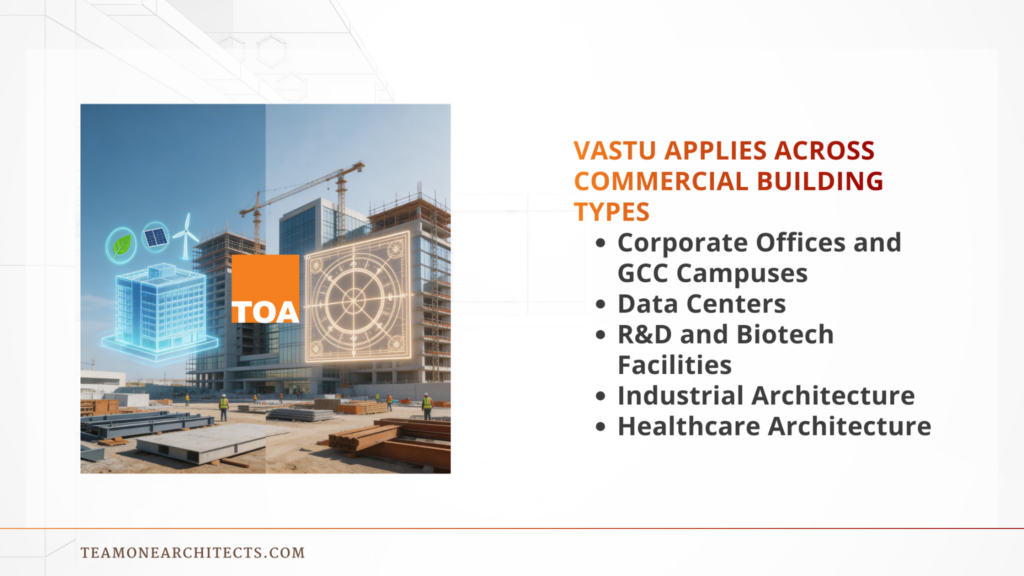
Sector-by-Sector Integration: How Vastu Applies Across Commercial Building Types
Corporate Offices and GCC Campuses
Incorporate workplace design and scalable GCC office design, Vastu integration typically centres on four decisions: main entrance orientation (north or east preferred), the Brahmasthan treatment, leadership zone placement, and the location of pantry/cafeteria facilities.
The Brahmasthan — the central zone of a building or campus — is perhaps the most powerful Vastu principle for large-scale corporate design. Vastu prescribes that this zone remain unobstructed, open, or lightly loaded: no heavy columns, no toilets, no mechanical rooms. In contemporary office planning, this translates naturally to the atrium, the central collaboration hub, or the campus courtyard — all of which are established tools for fostering organisational culture, visual connectivity, and informal exchange. The Brahmasthan atrium is simultaneously good Vastu and good workplace design.
Over the past two decades, Team One Architects has evolved its design philosophy from efficient space planning toward the creation of immersive spatial experiences — environments where brand identity is woven into the architecture through materials, graphics, lighting, and spatial sequencing rather than applied as a surface afterthought. In the context of Vastu-integrated corporate offices, this philosophy finds a natural home: the Brahmasthan becomes not just an open zone but a carefully crafted experiential centre — a double-height collaborative hub with warm textures, curated lighting, and brand-aligned feature walls that simultaneously honour the Vastu prescription and communicate the occupant organisation’s identity from the moment of arrival.
For Mumbai office interior design projects where floor plates are constrained by urban plot configurations, achieving textbook Vastu alignment is rarely possible without compromise. Skilled architecture firms in Mumbai typically adopt a hierarchy of Vastu priorities — securing the three or four most commercially significant prescriptions (main entrance, Brahmasthan, leadership zone, water placement) while using compensatory design elements — specific colour transitions, material contrasts between raw textures and warm finishes, and threshold spaces that signal directional shifts — to address constraints without sacrificing spatial coherence.
Scalable GCC offices present a particular opportunity: phased master plans can embed Vastu geometry into the long-range campus structure from the outset, ensuring that as buildings are added over 10–15 years, the aggregate campus composition remains directionally coherent. At Team One Architects, the shift from static office layouts toward dynamic, people-centric environments is central to how we approach this long-range planning. Where traditional cubicle-based offices once filled every square foot with fixed workstations, GCC campuses we design today incorporate open workstations, hot-desking, collaborative hubs, café-style breakout areas, and hybrid office layouts — all organised within an expandable framework that allows the campus to grow without disrupting the spatial logic that Vastu has anchored. Interior designers in Hyderabad working on IT andtech office design in Hyderabad have pioneered this phased Vastu master planning approach, particularly for pharmaceutical, IT, and financial services GCCs in the HITEC City and Financial District corridors.
Data Centers
Data center design presents what appears at first to be an irreconcilable tension with Vastu: the building type is almost entirely defined by its technical performance requirements — rack density, cooling efficiency, redundancy, security — rather than human occupation. Yet several Vastu principles align productively with data center design logic.
The southeast placement of electrical infrastructure (generators, UPS, switchgear) follows both Vastu’s Agneya fire-zone prescription and fire safety best practice. The avoidance of water elements in the northeast of a data hall — Vastu assigns northeast to water — aligns with the operational imperative to separate cooling water from primary electrical infrastructure. The southwest preference for mass and stability supports the placement of battery storage and structural shear walls, where mass concentration is both structurally beneficial and Vastu-aligned.
Fordata center design companies in Mumbai, working on the hyperscale facilities being developed across Navi Mumbai, Thane, and Pune’s Hinjewadi corridor, the more meaningful integration challenge is site orientation. Many data center sites are dictated by land availability, grid connectivity, and fibre infrastructure rather than directional orientation. In these cases,energy-efficient data center architecture in India is reconciled with Vastu through internal spatial organisation rather than building orientation — locating cooling towers, water treatment, and ancillary utilities according to directional logic, even when the primary building orientation is fixed by external constraints.
R&D and Biotech Facilities
R&D facility architects in India and biotech R&D facility architects in Hyderabad encounter some of the most nuanced Vastu integration challenges. Research facilities are simultaneously innovation environments — where human creativity and collaboration are paramount — and technical environments governed by containment, ventilation, and safety protocols that may override directional preferences.
The most productive approach is to apply Vastu to the non-laboratory zones: the central atrium or Brahmasthan as the hub connecting lab modules, north or east-facing write-up areas and offices to maximise diffused daylight for sustained cognitive work, and south or southwest placement for the most technically demanding and structurally heavy lab infrastructure. Ceremonial and administrative functions — the spaces where clients, leadership, and collaborators first experience the campus — can be Vastu-aligned with minimal technical compromise, communicating the organisation’s cultural values from the moment of arrival.
For modern tech office interior designers in Pune working on pharmaceutical R&D campuses in areas like Hinjewadi and Taloja, the integration of Vastu with GMP (Good Manufacturing Practice) compliance requirements is an emerging design challenge that requires close coordination between the architect, the Vastu consultant, and the client’s regulatory affairs team from the earliest stages of briefing.
Industrial Architecture
Industrial architecture firms in India have a long tradition of incorporating Vastu in factory and warehouse design — particularly for owner-managed businesses where the bhoomi puja (ground-breaking ceremony) and subsequent construction sequencing are guided by Vastu principles. For modular industrial architecture in Mumbai, the critical Vastu considerations typically involve the orientation of the main gate (north or east), the placement of the weighbridge and security cabin (southeast or south), the location of the boiler or furnace (southeast), and the positioning of the water storage or treatment facility (northeast or northwest).
The Brahmasthan principle is particularly relevant for industrial facilities: the central zone of a factory floor — often used as a primary assembly area or for heavy equipment placement — is better left as an unobstructed operational zone in both Vastu and lean manufacturing terms. The alignment between Vastu’s spatial philosophy and factory flow optimisation models (where obstructions in central circulation routes reduce throughput) is striking, and worth communicating to technically sceptical clients.
Healthcare Architecture
Healthcare architecture firms in India and sustainable healthcare architects in Mumbai occupy a uniquely significant intersection between Vastu and evidence-based design. The healing environment literature — which underpins frameworks like WELL Building Standard certification⁴ — is substantially aligned with Vastu’s prescriptions: natural light access, particularly in patient rooms and recovery areas; unobstructed circulation patterns; water features in arrival zones (Vastu’s northeast = north-facing reception, typically diffused-light-rich); and the avoidance of oppressive or heavy spatial configurations in patient-facing zones.
Team One Architects approaches healthcare environments with the same people-centric design sensibility that informs our corporate workplace projects: an emphasis on natural light optimisation, calm and balanced material palettes — where raw concrete and metal textures give way to warm, ergonomic, low-maintenance finishes in patient-facing zones — and tech-enabled conference and consultation rooms that support both clinical efficiency and staff well-being. In healthcare, these choices are not aesthetic preferences but clinical instruments. A well-lit, acoustically calm recovery corridor is a measurably better healing environment, and it is also better Vastu.
For large hospital campuses, Vastu integration begins at the master plan level: the positioning of the OPD (outpatient department) toward the north or east of the site for maximum visitor access and natural light; placement of the mortuary, waste management, and ancillary heavy services in the south or southwest; and the ICU and operation theatres — requiring the highest levels of stability, security, and controlled environment — in the southwest or south. These dispositions are not merely Vastu prescriptions; they also reflect best-practice hospital planning principles developed independently by organisations such as the Health Technical Memoranda (HTM) framework and the Indian Health Facility Guidelines.⁵
The Design Process: Integrating Vastu Without Compromising Delivery
Professional Vastu integration in large-scale commercial projects requires a defined methodology. The following framework reflects approaches developed by leading, award-winning architectural firms in India — including the client-centric, technology-driven process that Team One Architects has refined over more than two decades of practice.
Stage 1 — Brief Alignment (Pre-Design) The Vastu consultant, if appointed by the client, should be engaged at the same time as the architect — not called in at the end of schematic design to review a completed scheme. Late-stage Vastu corrections are expensive, structurally disruptive, and frequently superficial. At Team One Architects, we have shifted decisively from a designer-led model to a highly collaborative process that involves clients at every stage — understanding not just their spatial requirements but their operational rhythms, their brand values, and their business goals. Vastu priorities (which prescriptions are non-negotiable versus aspirational) are established in this first conversation, alongside the functional brief and the design intent.
Stage 2 — Site Analysis with Directional Mapping. Site orientation, prevailing wind, solar trajectory, and topography are mapped simultaneously with Vastu directional analysis. This dual-lens assessment frequently reveals natural alignments — a north-facing site boundary that favours a Vastu-compliant main entrance, or a slope from southwest to northeast that naturally supports the Vastu ideal of the ground rising toward the southwest. These alignments become design assets, reducing the cost and complexity of integration. Advanced 3D visualisation and walkthrough tools allow clients to experience these spatial decisions in immersive detail before a single structural element is committed — accelerating alignment and reducing late-stage design revisions.
Stage 3 — Master Plan and Block Composition. Vastu principles are applied first to the campus or building mass composition: the relative position of the main building, service buildings, parking structures, and landscape elements. This is where the highest-value Vastu decisions are made — and where the greatest alignment with sustainable site design is typically achievable. Expandable layouts are embedded into the master plan from the outset, ensuring that future growth can be accommodated without disrupting the directional logic of the initial composition.
Stage 4 — Floor Plan Configuration: Vastu directional logic is applied to the arrangement of major functional zones within each floor plate. The Brahmasthan is identified and protected. Entrance lobbies, executive zones, cafeterias, and service cores are positioned according to directional prescriptions, balanced against structural efficiency, MEP routeing, and fire egress requirements. Multi-functional zones — designed to serve as touchdown areas, informal meeting spaces, or café-style seating depending on the time of day — are positioned to activate the directional zones that Vastu assigns to social and collaborative energy.
Stage 5 — Interior Design and Materiality. Where structural or programmatic constraints prevent full directional alignment, interior design elements are used as compensatory and connective tools. Team One Architects has refined a material language that moves well beyond conventional finishes — combining raw textures such as metal and concrete with clean-lined modern materials and carefully balanced warm elements to create environments that are bold and expressive while remaining calm enough for sustained productive work. Feature walls, experiential zones, and factory-made furniture systems are deployed to reinforce spatial identity and brand storytelling throughout the floor plate. Corporate office interior design and Mumbai office interior design professionals increasingly find that this integrated material approach — which addresses both the Vastu prescription and the brand narrative simultaneously — produces more coherent and enduring results than treating them as separate design problems.
The Limits of Integration: Where Science and Tradition Must Negotiate
Honest professional practice requires acknowledging where Vastu prescriptions conflict with non-negotiable technical or regulatory requirements — and communicating those conflicts clearly to clients.
Fire egress and entrance orientation. National Building Code requirements for emergency egress may conflict with Vastu preferences for entrance placement. Fire exits must be located according to travel distance calculations, not directional philosophy. In these cases, the main ceremonial entrance can be Vastu-aligned while secondary functional entrances comply with egress requirements — a solution that typically satisfies both the client and the regulator.
Structural systems. The placement of the Brahmasthan as an open zone is incompatible with core-and-podium structural systems in which the central zone is occupied by the structural core, lifts, and staircases. For mid-rise commercial buildings of 10–20 storeys, alternative structural systems (perimeter cores, twin cores, or offset cores) can accommodate a central open zone, though at a premium on structural efficiency. This trade-off must be quantified and presented to clients as a genuine cost-benefit decision.
Plot geometry. Many urban commercial plots in Mumbai, Hyderabad, Bangalore, and Pune have irregular geometries, constrained frontages, or multiple road frontages that make textbook Vastu orientation geometrically impossible. In these cases, the Vastu Purusha Mandala — the sacred grid underlying Vastu spatial organisation — can be applied to the building’s internal geometry independently of the site boundary, creating a coherent internal spatial order even where the external orientation is constrained.
Toward a New Design Intelligence
The integration of Vastu Shastra in large-scale commercial architecture is not a return to the pre-modern. It is a recognition that India’s architectural tradition encoded centuries of accumulated environmental intelligence — intelligence that is increasingly legible through the lens of contemporary building science.
The most sophisticated practitioners — among thetop architects in Mumbai, top architectural firms in Bangalore, andsustainable architecture firms in Pune — are moving beyond the binary of “Vastu-compliant or not” toward a richer, more calibrated design intelligence: one that uses Vastu’s directional geometry as an organising framework for solar design, biophilic design, and human-centric planning, while remaining rigorously committed to structural performance, sustainability, and operational efficiency.
Across our corporate office portfolio, Team One Architects has demonstrated what this integration looks like in practice: conventional layouts transformed into agile, people-centric workspaces; collaborative zones and breakout areas integrated seamlessly into Vastu-directed floor plate compositions; materials, lighting, and graphics deployed in concert to communicate brand values through the built fabric rather than applied decoration. The result, consistently, is environments that directly influence how teams interact, how organisations retain talent, and how brands are experienced — the tangible design impact that distinguishes a thoughtful architectural practice from a planning exercise.
For the clients commissioning India’s next generation of corporate campuses, data centers, biotech R&D facilities, industrial parks, and healthcare institutions, this integrated intelligence — rooted in both ancient spatial science and contemporary building technology — offers something that neither tradition alone can provide: environments that perform brilliantly by every measurable metric, and that feel, unmistakably, right.
Team One Architects brings this dual perspective to every large-scale project across India’s primary commercial centres. Explore our approach to sustainable corporate office design, GCC campus architecture, and high-performance data center design, or connect with our team through the India Answers Hub to discuss your project.
References
- Dagens, Bruno. Architecture in the Āgamas. Sitaram Bhartia Institute of Scientific Research, 1984. Canonical Vastu texts include Manasara (c. 5th–7th century CE), Mayamata (c. 9th–10th century CE), and Brihat Samhita (c. 6th century CE).
- Nabil, A., & Mardaljevic, J. “Useful daylight illuminance: A new paradigm for assessing daylight in buildings.” Lighting Research and Technology, 37(1), 41–59 (2005). Applied to Indian climate zones by National Building Code of India 2016, Part 8, Section 1.
- NASSCOM. India GCC Landscape Report 2025. National Association of Software and Service Companies, New Delhi, 2025. India hosts 1,800+ GCCs employing ~2 million professionals.
- International WELL Building Institute. WELL Building Standard v2. New York, 2020. Daylighting, air quality, and thermal comfort credits align substantively with Vastu directional prescriptions for north/northeast orientation and Brahmasthan openness.
- Ministry of Health and Family Welfare, Government of India. Indian Health Facility Guidelines (IHFG). New Delhi, 2012. OPD placement, service zone separation, and mortuary positioning guidelines align with Vastu prescriptions for hospital site planning.