

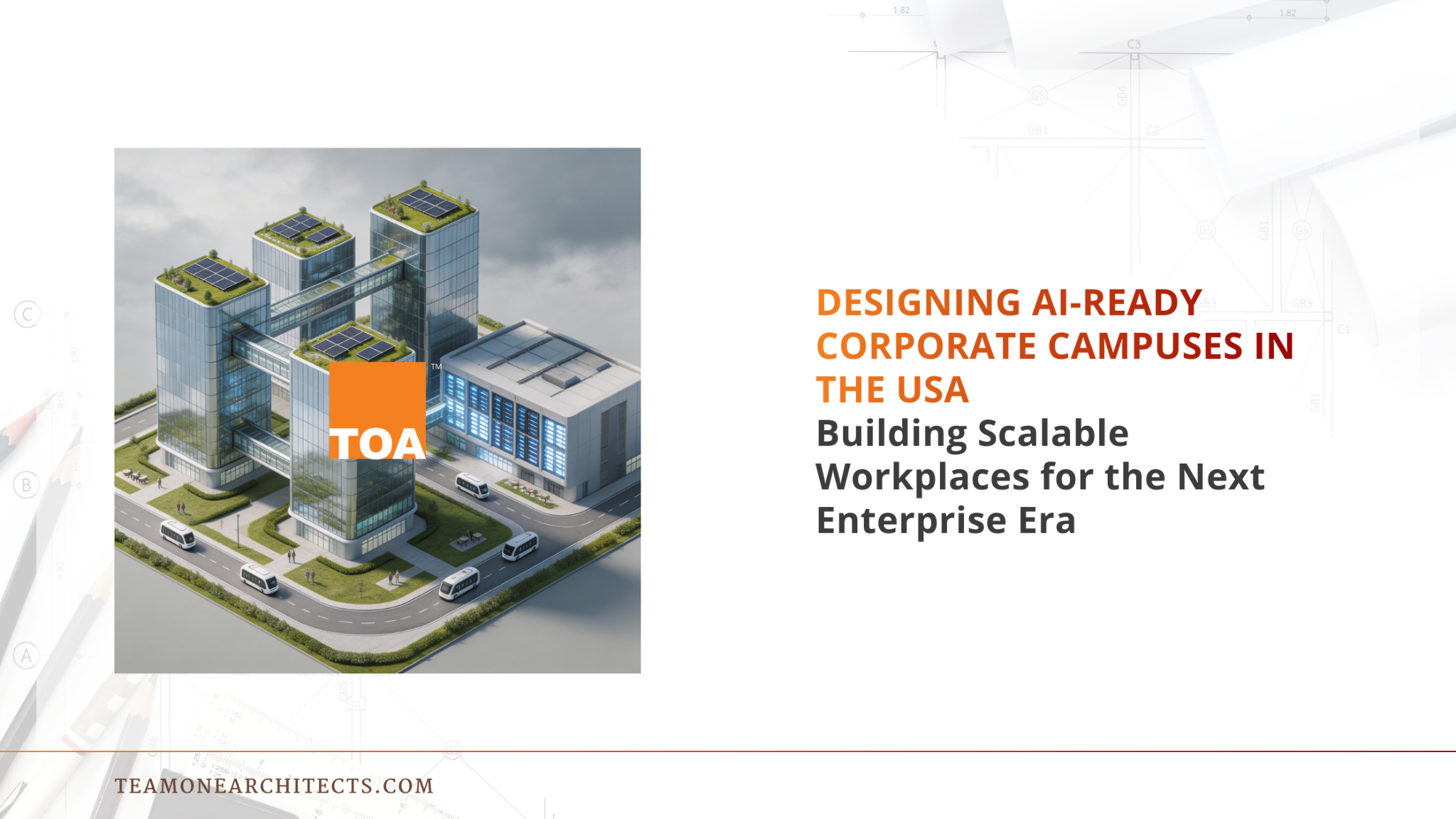
Designing AI-Ready Corporate Campuses in the USA: Building Scalable Workplaces for the Next Enterprise Era
Something fundamental shifted in the American corporate campus brief between 2023 and 2026. For decades, the dominant design questions were about density, collaboration, and hybrid flexibility — how many people fit, how they move between focus and meeting, and how quickly the space can be reconfigured. Those questions remain, but they are no longer the lead. Today, the first conversation between a corporate real estate director and their design team is more likely to centre on a different set of concerns: How much power does this building need? Can the floor slab carry the AI infrastructure load? Is the cooling strategy ready for a rack density that may triple in five years? And — underneath all of it — can this campus attract and retain the engineering and scientific talent that will actually build the AI systems?
The AI-ready corporate campus is not simply a conventional office with a data hall attached. It is a new building typology: one that must simultaneously perform as a high-density technical infrastructure facility, a compelling human workplace, and a credible expression of corporate sustainability commitments. For architects in New York, architectural firms in San Francisco, architects in Austin, and architects in Chicago navigating this shift, the design challenge is both technical and cultural — and it rewards a sophisticated integration of both.
This article examines the architectural imperatives driving the AI-ready campus, how they manifest differently across the USA’s leading enterprise markets, and what the most forward-looking organisations are building today to stay competitive through the next enterprise era.
The Structural Forces Driving Demand
The scale of corporate AI investment in the United States is reshaping physical infrastructure at a pace that most real estate teams were not prepared for. U.S. hyperscalers and major technology companies committed over $500 billion in combined capital expenditure toward AI and data infrastructure in 2025 alone, with analysts projecting global data center capacity to double by 2030.¹ The Semiconductor Industry Association reported that AI-driven workloads now account for the majority of new computing infrastructure procurement, and that this demand is cascading from hyperscale facilities into the on-premise and near-premise infrastructure requirements of enterprise corporate campuses.²
The consequences for campus design are direct and structural. AI training and inference workloads require power densities per rack that are four to ten times those of conventional enterprise computing — and those density figures are still rising. An enterprise AI lab that was designed for 10–15 kW per rack in 2022 may need to accommodate 50–100 kW per rack by 2027 if the organisation keeps pace with model generation cycles. Floor slabs, structural bays, cooling plant, electrical switchgear, and standby generation systems that were adequate for a conventional corporate campus are frequently inadequate for an AI-ready one, and the retrofit cost of upgrading them after occupancy is prohibitive.
The most sophisticated corporate clients have recognised this. They are briefing their design teams not for what they need today, but for what they will need across a 15–20 year building lifecycle. The result is a new generation of corporate campuses designed for AI-readiness from the foundation slab up.
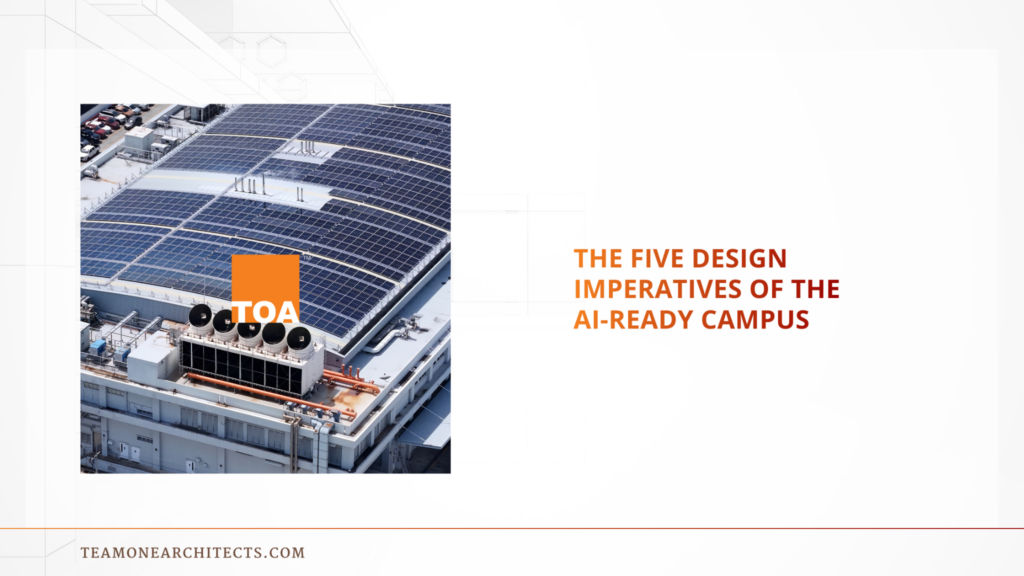
The Five Design Imperatives of the AI-Ready Campus
1. Power and Electrical Infrastructure at Enterprise Scale
The starting point for any AI-ready campus design is an honest reckoning with power. Enterprise AI operations — even those that rely primarily on cloud computing for training but maintain on-premise inference, data preprocessing, and secure AI environments — require electrical infrastructure substantially in excess of conventional corporate specifications.
A campus of 250,000 sq. ft. designed for conventional enterprise occupancy might be specified at 50–80 watts per sq. ft. for its technical zones. An AI-ready equivalent, with dedicated ML inference rooms, edge computing nodes, and secure AI processing environments, may require 150–300 watts per sq. ft. in those technical zones, with the remainder of the floor plate at conventional specification. The critical design decision is not which figure to build to — it is how to build a primary electrical infrastructure robust enough to serve the peak technical demand while maintaining the flexibility to scale the technical zones progressively as the organisation’s AI footprint grows.
Scalable tech office interior designers in New York are embedding this logic into the structural brief from day one: oversizing the primary transformer capacity and switchgear by a planned margin, designing generator and UPS rooms for future expansion, and routing dedicated power risers to every floor, even where current occupancy does not require them. The capital cost premium of this forward-specified electrical infrastructure is typically 8–12% of the M&E budget — a fraction of the cost of a later retrofit, and a rounding error relative to the opportunity cost of an AI operation constrained by infrastructure.
2. Cooling Strategy for High-Density Compute
Heat management is the most consequential technical design challenge in the AI-ready campus. Conventional air-cooled CRAC (Computer Room Air Conditioning) systems are inadequate for rack densities above approximately 20 kW — a threshold that enterprise AI environments routinely exceed. The architectural design of an AI-ready campus must accommodate at minimum one, and ideally two or three, advanced cooling strategies deployed in combination.
Direct-to-chip liquid cooling circulates coolant directly to heat-generating processor components, achieving heat rejection efficiencies that air cooling cannot approach. It requires structural provisions for coolant distribution manifolds, leak detection systems, and containment drainage — all of which must be integrated into the slab and interstitial floor design from the outset.
Rear-door heat exchangers are a lower-disruption option for retrofitting existing facilities, but in new construction, they represent a compromise: they can handle rack densities up to approximately 30–40 kW but are inadequate for the 100 kW+ rack densities that leading AI infrastructure is moving toward.
Immersion cooling — in which servers are submerged in dielectric fluid tanks — is emerging as the long-term solution for the highest-density AI compute environments. It requires substantial structural loading accommodation (immersion tanks are significantly heavier than conventional server racks), dedicated fluid management infrastructure, and MEP routing strategies that differ fundamentally from air-cooled configurations.
AI data center design companies and hyperscale data center architects in the Bay Area and Austin are specifying a cooling plant with explicit provision for technology migration — designing the primary chilled water loops, heat rejection systems, and structural bays to accommodate all three cooling approaches, even where only one is deployed at opening. This future-proofing strategy is the defining characteristic of AI-ready campus cooling design.
3. Structural and Floor-Plate Design for Technical Agility
The structural brief for an AI-ready campus departs from conventional corporate office specifications in several critical respects. Floor-to-floor heights must accommodate deeper interstitial services voids — typically 900–1,200mm versus the 450–600mm conventional in commercial office construction — to allow the power and cooling distribution infrastructure required for high-density compute. Raised access floors are returning to specification in technical zones after years of being designed out of corporate offices, precisely because the density and mutability of AI infrastructure routing require the access flexibility they provide.
Structural bay dimensions must accommodate both dense technical environments and open collaborative floor plates without internal column interruption. A 12m × 12m or 15m × 15m structural grid — slightly larger than the 9m × 9m conventional in commercial construction — provides the column-free spans that allow technical zones to be fully reconfigured as rack layouts evolve, while equally supporting the open collaborative neighbourhoods that characterise contemporary corporate workplace design.
Floor load capacity in technical zones must be specified at a minimum of 12–15 kN/m² (substantially above the 3–4 kN/m² conventional for office occupancy) to accommodate server racks, cooling infrastructure, and UPS batteries. For immersion cooling deployments, local point loads of 25–30 kN/m² must be accommodated. These structural specifications are most economically achieved through a split-slab strategy: technical zone bays designed to enhance structural specification, with collaborative and office zones at standard loading, the two connected by generous transition corridors that serve as both spatial and structural buffers.
4. Workplace Design as Talent Infrastructure
The AI talent market in the United States is among the most competitive in the world. According to the Stanford AI Index 2025, the United States trained approximately 40% of the world’s AI PhDs in 2024, yet demand for qualified AI researchers, ML engineers, and data scientists continues to substantially exceed supply.³ For the enterprises commissioning AI-ready campuses, the quality of the physical workplace is not a secondary consideration to technical infrastructure — it is, in the talent competition, equally decisive.
The research on workspace and cognitive performance is unambiguous: natural light access, acoustic quality, thermal comfort, and access to restorative outdoor or biophilic environments are each independently correlated with sustained cognitive performance, creativity, and organisational retention.⁴ For an organisation that depends on the concentrated intellectual output of highly sought-after engineers and researchers, the workplace is a productivity asset — and one that can be measured.
Corporate office interior design for AI-era campuses reflects this understanding through several design strategies that Team One Architects has developed and refined across two decades of corporate workplace projects. Deep floor plates — which maximise lettable area but condemn interior zones to artificial light — are being replaced by narrower, more naturally lit floor plates even at the cost of some planning efficiency. The shift from fixed workstation grids to activity-based planning is fundamental: open workstations, hot-desking, and modular furniture systems give teams the flexibility to reconfigure their environments as projects, team sizes, and working patterns change — without construction or capital expenditure. Collaborative hubs, breakout areas, and café-style seating zones are embedded into the floor plate as programmatic anchors, not afterthoughts, designed to foster the informal idea exchange that structured meeting rooms cannot replicate.
Ceiling heights in collaborative zones are being designed above the commercial minimum of 2.7–3.0m, with 3.6–4.2m specifications in key community spaces, to create the sense of volume and spatial generosity that differentiates a campus from a generic office. Material choices reinforce this spatial ambition: the most effective AI-era workplaces move beyond conventional finishes toward a bolder, more expressive palette — raw textures such as exposed concrete and metal in industrial or contemporary zones contrasted with warm, ergonomic materials in focus and well-being areas, creating a balanced environment that is stimulating without being exhausting. Feature walls and experiential zones, often carrying brand graphics or mission statements, punctuate the floor plate and anchor wayfinding. Factory-made furniture systems — specified for durability, modularity, and low maintenance — are increasingly preferred over bespoke items that cannot be easily reconfigured as the organisation evolves.
Modern tech office interior designers in Austin and tech office design firms in San Francisco are consistent in citing biophilic integration — living walls, interior courtyards, campus landscape connective tissue — as among the most effective and cost-efficient investments for talent attraction and retention.
The intersection of technical and human-centric design is perhaps most visible in the campus amenity programme. AI-era corporate campuses in San Francisco, Austin, New York, and Chicago are investing in on-campus amenities — high-quality food, fitness, maker spaces, dedicated quiet zones, and after-hours social infrastructure — at levels previously associated only with hyperscaler “perks culture.” The rationale has shifted from culture to strategy: when talent can work remotely, the campus must offer a compelling reason to be present that goes beyond the desk. Brand storytelling — expressed through materials, lighting, spatial sequencing, and experiential zones that communicate the organisation’s identity and values — is one of the most powerful tools available for creating that compelling reason.
5. Net-Zero and Energy Accountability
The AI campus faces a sustainability paradox: the same AI systems that many organisations are deploying to optimise their sustainability performance require energy-intensive physical infrastructure that, if designed conventionally, would dramatically increase the organisation’s operational carbon footprint. Resolving this paradox is the defining sustainability challenge of the AI-ready campus — and it is one that design has a central role in addressing.
Net-zero architecture firms working on AI campus projects typically pursue a four-part strategy. First, the building envelope and passive design systems — insulation, glazing specification, solar shading, and natural ventilation where feasible — are optimised to minimise the heating and cooling load of the occupied portions of the campus. Second, on-site renewable generation — typically rooftop and car park canopy photovoltaics — is maximised within site constraints, with battery energy storage systems (BESS) specified to shift generation to periods of peak technical demand. Third, the waste heat from high-density compute environments is captured and repurposed, either for domestic hot water, space heating in cooler climates, or — in some advanced campus designs — for district energy distribution to adjacent facilities. Fourth, for the remaining Scope 2 emissions that cannot be eliminated through on-site generation, Power Purchase Agreements (PPAs) with renewable generators are structured as a core component of the campus operating model, not an afterthought.
LEED consultants in California and energy-efficient data center architecture specialists are increasingly working in integrated teams from the earliest design stages — not as compliance consultants reviewing a completed scheme, but as co-designers shaping the building’s fundamental energy logic from site selection onwards.
City-by-City: How AI Campus Design Manifests Across U.S. Markets
New York: Density, Compliance, and Financial Services AI
New York’s AI campus market is dominated by financial services, professional services, and media corporations deploying AI for quantitative analytics, risk modelling, automated compliance, and content operations. The design constraints are those of New York’s commercial real estate market: high land values, existing building stock, floor plate efficiency demands, and a regulatory environment that includes Local Law 97’s carbon intensity limits, which mandate significant reductions in building emissions with financial penalties for non-compliance from 2024 onwards.⁵
Corporate workplace design in New York for AI-era occupants, therefore, tends toward intelligent retrofits and targeted upgrades of existing Class A stock — enhancing electrical infrastructure, adding liquid cooling provisions to dedicated technical floors, and improving the workplace environment through interior design and amenity investment — rather than ground-up campus construction. The most sophisticated architects in New York are developing detailed playbooks for AI-readying existing buildings: a phased investment framework that sequences electrical upgrades, cooling augmentation, and workplace renovation in priority order, calibrated to each building’s structural constraints and each occupant’s AI deployment timeline.
Sustainable healthcare architects in New York add a further dimension: the city’s major medical centres — NYU Langone, Mount Sinai, NewYork-Presbyterian — are deploying AI at scale for clinical decision support, diagnostic imaging, and genomics research, creating a growing demand for purpose-designed AI-ready research and clinical facilities that combine HIPAA-compliant data environments with human-centric clinical workplaces.
San Francisco Bay Area: The Originating Market
The Bay Area remains the global originating market for AI-ready campus design. The density of AI-native companies, the talent ecosystem’s design expectations, and the proximity to the technology’s fastest-evolving practitioners mean that design innovations — in cooling strategy, workplace programming, sustainability integration, and structural specification — typically appear in Bay Area campuses several years before they reach other markets.
Biotech R&D facility architects in San Francisco are at the leading edge of a particularly demanding design challenge: the convergence of AI and life sciences, in which computational biology, AI-accelerated drug discovery, and large-scale genomic data processing are creating facilities that must simultaneously function as precision laboratory environments and high-density AI compute campuses. The architecture firm in San Francisco capable of integrating cleanroom-grade lab environments, AI inference infrastructure, seismic resilience (critical in a Zone 4 seismic environment), and biophilic, retention-focused workplace design is operating at the frontier of global commercial architecture.
The Bay Area’s commitment to LEED consultants in California and net-zero architecture is entrenched — partly through corporate ESG commitments, partly through California’s Title 24 energy code, among the most demanding in the world, and partly through a genuine cultural expectation among Bay Area tech talent that their employer’s physical environment should reflect its stated values. AI campuses here are almost universally designed to LEED Platinum or equivalent, with a growing number targeting Living Building Challenge certification for flagship facilities.
Austin: Scalability as the Core Value Proposition
Austin’s emergence as a major corporate AI campus market reflects the city’s dual advantage: a rapidly growing technology talent pool — driven by university output from UT Austin and the post-pandemic migration of tech companies from higher-cost markets — and land availability at a campus scale that New York and San Francisco cannot match at any comparable economics.
IT office design in Austin and GCC office interior designers in Austin are designing for growth trajectories that their counterparts in coastal markets rarely encounter: organisations arriving in Austin with 500 employees and a credible plan to reach 5,000 within a decade, who need a campus that can accommodate that growth without reconstruction. Scalability — modular expansion from the master plan, flexibility of core and shell specification, and the discipline to avoid design decisions that foreclose future growth options — is the dominant design value in Austin’s AI campus market.
The energy economics of Austin are also distinctively favourable for AI-ready campuses: Texas’s deregulated electricity market, the large-scale renewable generation capacity of ERCOT’s grid, and access to substantial on-site land for photovoltaic installation create conditions in which AI campuses can achieve meaningful on-site renewable generation at lower cost than in most U.S. markets. Sustainable architecture firms in Austin are capitalising on these economics to design campuses with on-site renewable fractions of 40–60% — a figure that would be economically marginal in Manhattan or central San Francisco, but is achievable and commercially rational in Austin’s suburban campus context.
Chicago: The Midcontinent Infrastructure Hub
Chicago’s AI campus market is shaped by the city’s role as the mid-continent hub for financial technology, logistics, and enterprise software. Its central U.S. geography makes it a natural location for AI infrastructure serving organisations with distributed national operations — and its grid infrastructure, data connectivity, and access to talent from a dense higher education ecosystem support credible campus-scale AI deployments.
IT office design in Chicago for the AI era tends toward the hybrid model: large, mixed-use campuses that combine conventional corporate workplace design with dedicated AI infrastructure zones, designed to serve both as talent-attracting workplaces and as regional AI compute hubs. The city’s architectural heritage — the deep Chicago tradition of structural innovation and spatial rigour — is being brought to bear on this new building typology with results that reflect both technical ambition and spatial quality.
Boston: Life Sciences and the AI–Research Convergence
Boston’s Kendall Square and the broader Cambridge innovation district represent the most concentrated convergence of life sciences, academic research, and commercial AI in the United States. Life sciences architecture firms in Boston are designing for a client base in which AI is not a technology layer applied to an existing research operation — it is foundational to the research model itself, from target identification and compound screening to clinical trial design and regulatory submission.
The design consequence is that Boston’s AI-ready research campuses are among the most technically complex buildings being designed anywhere in the world: combining BSL-2 and BSL-3 containment laboratories, cGMP manufacturing suites, high-density AI compute environments, and compelling human-centric workplaces in buildings that must meet the most demanding regulatory standards applied to any commercial building type. The R&D facilities design architects capable of navigating this complexity — integrating NIH compliance, FDA GMP requirements, OSHA laboratory safety standards, LEED certification, and AI infrastructure specification into a coherent design — represent the highest-value tier of specialist practice in the U.S. market.
Los Angeles: Entertainment, Media, and the Creative AI Campus
Architects in Los Angeles are designing for a distinctively different application of AI in the campus brief: the convergence of creative production, AI-generated content tools, and the infrastructure required to train, deploy, and iterate on large creative AI models. The major studios, streaming platforms, and creative technology companies headquartered in Los Angeles are investing in campuses that must serve simultaneously as creative production environments — where the human experience of the space is paramount — and as AI compute facilities.
The design challenge in Los Angeles is therefore the most acute version of the AI campus’s central tension: technical infrastructure and human workplace design must be integrated at a level where neither can be treated as secondary. The city’s climate — mild, with abundant natural light and outdoor living culture — creates conditions in which campus landscape, outdoor work environments, and biophilic integration are not optional amenities but core design strategies, supporting the creative culture that these organisations need their physical environment to embody.
Global Capability Centers: AI Campus Design for India-Origin Enterprises
A growing share of U.S. AI campus investment is being driven by India-origin enterprises and Indian-led GCC operations establishing or expanding their American footprint. These organisations bring a design sensibility shaped by India’s GCC campus evolution — where scalability, operational density, and sustainability integration have been refined through the development of global capability center design campuses for over two decades — and are applying that sensibility to U.S. campus briefs with distinctive results.
The U.S. GCC campus differs from its Indian counterpart in several key respects: higher land and construction costs demand greater programmatic intensity per square foot; American workplace culture places greater emphasis on individual workspace quality; and the regulatory and compliance environment — ADA accessibility, local energy codes, seismic and wind standards — varies significantly by city and state. But the strategic design logic — phased master planning, modular scalability, security zoning for IP-sensitive operations, and technology integration for intelligent campus operations — is directly transferable.
GCC office interior designers in Austin and IT office design specialists in Chicago working with Indian-origin enterprise clients are consistently finding that these organisations bring a longer planning horizon and a more disciplined approach to phased infrastructure investment than their U.S.-origin counterparts — an approach that serves them well in designing AI-ready campuses where the most important design decisions are those that protect future options rather than optimise for current conditions.
The Design Process for AI-Ready Campuses: What Leading Organisations Are Doing Differently
The organisations commissioning the most successful AI-ready campuses in 2026 share a set of process characteristics that distinguish their design outcomes from the average. The best design practices share these characteristics too — and they map closely to the approach Team One Architects has developed across two decades of corporate, technology, and mission-critical projects.
They start with an AI infrastructure brief, not a workplace brief. The technical requirements — power density, cooling strategy, structural loading, connectivity, security zoning — are defined before the first floor plan is sketched. This inversion of the conventional design sequence prevents the most common and costly failure mode of AI campus projects: a workplace design optimised for conventional occupancy that cannot accommodate the technical infrastructure when it arrives.
They appoint the MEP engineer, structural engineer, and sustainability consultant at the same time as the architect. The AI-ready campus is fundamentally an integrated engineering challenge. Design decisions made by the architect in the first weeks of a project — structural grid, floor-to-floor height, building orientation, core placement — determine the cost and feasibility of every subsequent MEP and sustainability decision. Integrated project delivery from day one, with all disciplines contributing to the schematic design simultaneously, is not a preference but a necessity.
They leverage advanced visualisation to accelerate alignment. At Team One Architects, the adoption of advanced 3D visualisation and walkthrough tools has fundamentally changed how clients engage with design decisions — particularly the high-stakes, technically complex decisions that characterise AI campus projects. When a client can experience a proposed structural bay configuration, a cooling plant routing strategy, or a collaborative neighbourhood layout in an immersive walkthrough, they can make better decisions faster. This technology-driven design process compresses the schematic design phase, reduces costly late-stage revisions, and builds the confidence that allows ambitious technical and spatial commitments to be made early.
They invest in lifecycle cost modelling, not just capital cost comparison. An AI-ready campus designed for a 20-year technology evolution typically costs 12–18% more to build than a conventional corporate campus of equivalent area. But the lifecycle cost comparison — accounting for avoided retrofit costs, energy savings from integrated sustainability systems, reduced churn costs from a workplace that retains talent, and the productivity value of AI infrastructure that scales with organisational need rather than requiring replacement — consistently favours the AI-ready specification by a margin of 2:1 or greater over a 15-year horizon.⁶
They treat corporate office interior design as a performance investment. The organisations achieving the best talent retention outcomes from their AI campuses are those that have applied the same rigour to the human workplace — lighting quality, acoustic performance, biophilic integration, brand storytelling through the built environment, amenity programme — as to the technical infrastructure. In the AI talent market, the quality of the physical environment is a competitive differentiator that is legible to candidates from the moment they step onto a campus. The shift from space planning to experience creation — from efficient layouts to immersive spatial identities that communicate organisational values — is what separates the campuses that attract and retain exceptional talent from those that merely house it.
Toward the AI-Ready Campus: A Design Synthesis
The AI-ready corporate campus is not a solved typology. It is an evolving design challenge, shaped by technology trajectories that are themselves uncertain, in markets with different constraints and cultures, for organisations with different AI maturity levels and different talent narratives. No two AI-ready campuses are, or should be, identical.
What they share — and what distinguishes the best from the merely adequate — is a design intelligence that holds technical performance and human experience in productive tension: infrastructure specified for the AI systems that will define the organisation’s competitive position over the next decade, and workplaces designed for the people who will build and operate those systems. Across corporate office and GCC campus projects, Team One Architects has demonstrated what this integration looks like when it is executed well: conventional static layouts transformed into agile, people-centric environments; collaborative zones, breakout areas, and informal meeting spaces integrated at the scale of the floor plate; materials, lighting sequences, and brand graphics deployed together to communicate organisational values through the fabric of the building itself; and expandable layouts that allow the campus to grow with the organisation rather than against it. These are not aesthetic decisions — they are operational and strategic ones, with measurable consequences for productivity, retention, and brand.
The organisations that understand both requirements — technical AI infrastructure and human spatial experience — and commission design teams capable of integrating them with rigour and creativity, are building the campuses that will define the next enterprise era.
Team One Architects brings cross-market expertise in scalable GCC campus design, high-performance data center architecture, sustainable corporate office design, and mission-critical facilities to every AI campus engagement. Explore our design approach through the USA Answers Hub, review our portfolio, or connect with our team to discuss your AI campus initiative.
References
- JLL Global Data Center Outlook 2026; Data Center Knowledge / Moody’s Capital Expenditure Analysis, January 2026. Combined hyperscaler capex commitments toward AI and data infrastructure exceeded $500 billion in 2025.
- Semiconductor Industry Association. State of the U.S. Semiconductor Industry 2025. Washington D.C., 2025. AI-driven workloads now represent the majority of new enterprise computing infrastructure procurement.
- Stanford University Human-Centered AI Institute. AI Index Report 2025. Stanford, CA, 2025. The U.S. trained approximately 40% of global AI PhDs in 2024; demand for AI researchers continues to significantly exceed supply.
- Leesman Index. The World’s Greatest Workplace Study: Volume 3. London, 2024. Independent analysis of 750,000+ employee workplace experience assessments confirms correlation between natural light access, acoustic quality, and sustained cognitive performance.
- New York City Local Law 97 (Climate Mobilization Act), enacted 2019, effective 2024. Mandates carbon intensity limits for buildings over 25,000 sq. ft. with escalating financial penalties through 2050.
- Urban Land Institute & Aecom. The Business Case for High-Performance Buildings. Washington D.C., 2023. Lifecycle cost analysis of high-performance versus conventional commercial construction demonstrates 2:1+ cost advantage for high-performance specification over 15-year horizons.