

Designing Global Capability Centers for Performance, Scale and Talent Retention
India hosts over 1,800 GCCs, employing nearly 2 million professionals and contributing approximately USD 64–65 billion in annual revenue, with Bengaluru, Hyderabad, Pune, and NCR as primary hubs. These centers have shifted from cost-arbitrage models to high-value strategic entities driving AI, R&D, and digital transformation. Architectural design plays a pivotal role in supporting this evolution, enabling scalable campuses that accommodate multi-phase growth, foster collaboration, ensure security, and prioritize employee well-being to reduce attrition in competitive talent markets.
Strategic Planning Frameworks for Multi-Phase GCC Campuses
Effective GCC design begins with master planning that anticipates phased expansion over 5–10 years, aligning built environment with organizational maturity—from initial setups to mature innovation hubs. Core principles include modular zoning for future adaptability, vertical and horizontal circulation efficiency, and integration of shared amenities to build campus identity.
In Bengaluru, where ~29–40% of GCCs concentrate, designs emphasize deep tech ecosystems with flexible floor plates. Explore how architectural firms in Bangalore approach tech-enabled workspace design.

Spatial Efficiency and Circulation Optimization
Large-scale campuses require high net-to-gross ratios through efficient core placement, wide circulation spines, and minimized dead zones. Open-plan floors with 10–15 m column grids support adaptable layouts, while atria and vertical connectors enhance natural light penetration and wayfinding across phases.
Flexibility and Hybrid Work Integration
Hybrid models dominate, with 95% of GCCs adopting flexible arrangements. Designs incorporate diverse zones: collaboration hubs, focus pods, touchdown areas, and modular furniture for rapid reconfiguration. This supports role-based flexibility—more onsite for secure labs, hybrid for analytics teams—while promoting retention through ergonomic, wellness-oriented environments.
In Pune, future-ready commercial spaces prioritize adaptability. See how top architects Pune design future-ready commercial spaces.
Flexible open-plan zones in a GCC campus, enabling hybrid collaboration and quick reconfiguration (image sourced from internal portfolio, e.g., Johnson Controls GCC offices).
Security Zoning and Compliance Considerations
Security remains paramount for IP-sensitive operations. Layered zoning—public reception, semi-secure collaboration areas, high-security labs/R&D floors—uses access-controlled cores, mantraps, and segregated MEP systems. Designs incorporate secure visitor management, biometric integration, and compartmentalized networks to meet global standards without compromising spatial flow.
Technology Integration for Intelligent Campuses
Smart building systems are essential: IoT for occupancy-based HVAC/lighting (reducing energy by 20–30%), AI-driven space booking, and seamless AV for global connectivity. Integration supports data-driven operations, from predictive maintenance to employee experience analytics, aligning with ESG goals and enhancing productivity.
Hyderabad’s rapid GCC growth benefits from scalable, tech-forward designs. Refer to the considerations when hiring architects Hyderabad.
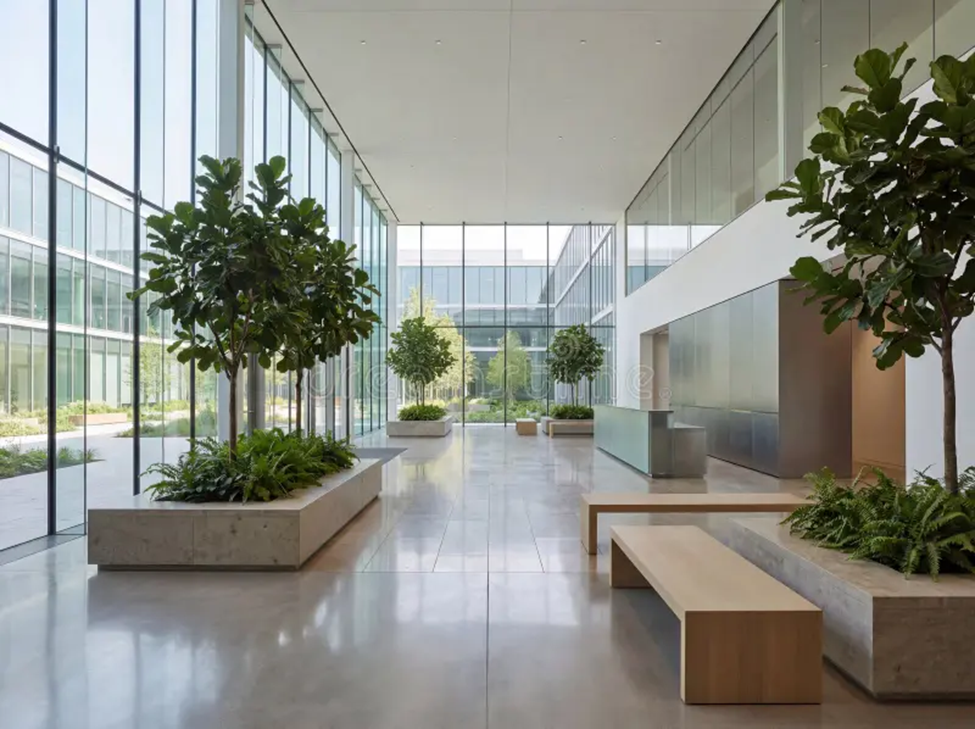
Technology-integrated atrium in a multi-phase GCC campus, facilitating secure yet collaborative environments (internal source recommended).
Regional Variations and Talent Retention Drivers
- Bengaluru: Deep talent pools demand biophilic, amenity-rich campuses with wellness zones to combat urban density pressures.
- Hyderabad: Cost-competitive sites favor large-footprint campuses with green building features for sustainability and retention.
- Pune: Engineering-focused GCCs prioritize modular industrial architecture elements for R&D scalability.
- NCR: Diversified operations require hybrid zoning blending corporate and tech aesthetics.
These designs contribute to lower attrition by emphasizing purpose-driven spaces that reinforce culture and global alignment.
Architectural Role in GCC Evolution
As GCCs mature into AI-native, business-first entities, architectural frameworks must prioritize scalability, security, flexibility, and human-centric elements. Thoughtful design not only accelerates multi-phase delivery but also strengthens talent retention in India’s competitive landscape.
Team One Architects brings expertise in GCC office design and sustainable workspaces. Explore further in the India Answers Hub, view projects in the portfolio, or connect via the about us page to discuss your GCC initiative. Additional insights on sustainable trends are available in our article on sustainable corporate office design trends India 2026.
References
- Gratuity Consulting, “India GCC Growth in 2026: Talent, AI, Policy & Strategy” (January 2026).
- Flexiple, “Global Capability Centers in India (2026): City-Wise List & Insights” (December 2025).
- Zyoin, “The Nano GCC Phenomenon” (January 2026).
- Press Information Bureau (PIB), Government of India, “From Policy to Prosperity: GCCs Leading India’s Growth Journey” (December 2025).