

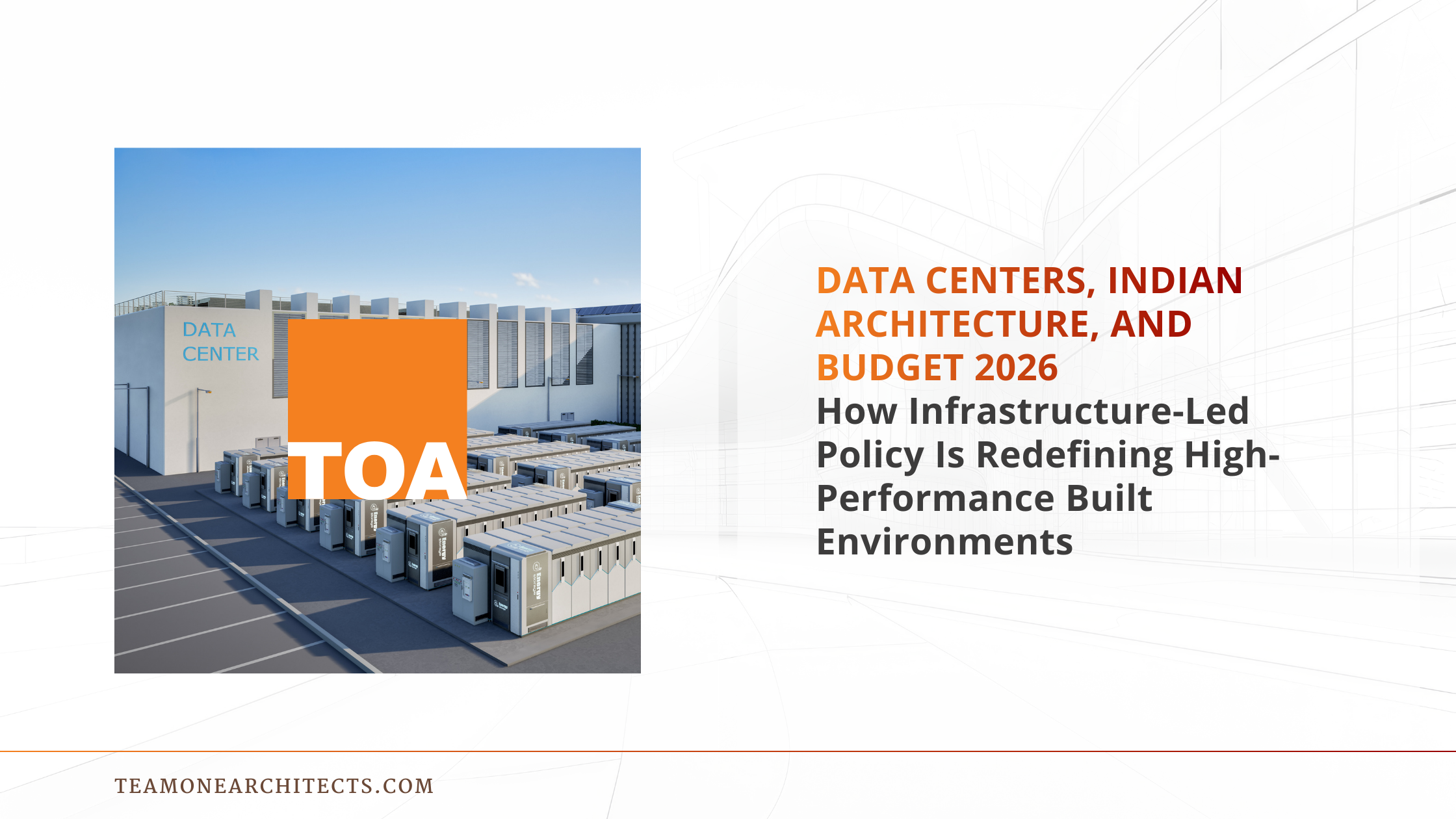
Data Centers, Indian Architecture, and Budget 2026: How Infrastructure-Led Policy Is Redefining High-Performance Built Environments
The Union Budget 2026–27 introduces landmark incentives for digital infrastructure, notably a tax holiday until March 31, 2047, for foreign companies providing cloud services from India-based data centers, alongside a 15% safe harbour on costs for related entities. These measures, combined with broader infrastructure allocation and energy transition support, signal a structural shift toward hyperscale and AI-ready facilities. India’s data center capacity, currently around 1.2–1.5 GW, is projected to reach 1.7–1.8 GW by year-end, with market value estimated at USD 11–12 billion and growing at 14–16% CAGR through the early 2030s.1,2 This policy impetus demands architectural responses focused on energy efficiency, modularity, and sustainability to manage high-density computing loads while advancing net-zero objectives.
Contemporary hyperscale data center campus in Mumbai region, exemplifying modern facade treatments and scalable massing driven by recent investments. Emerging hyperscale facility in Chennai, showcasing integrated architectural expression for high-performance digital infrastructure.
Policy Framework and Incentives
Budget 2026 prioritizes data centers as core national infrastructure through long-term tax stability and transfer pricing clarity. The extended tax holiday attracts global hyperscalers, while duty exemptions on battery energy storage systems (BESS) and capital goods support grid resilience and renewable integration. These align with India’s digital economy ambitions, reducing operational risks and encouraging investments in energy-efficient data center architecture India.
Market Growth and Capacity Projections
Operational stock has surged, with Mumbai commanding ~40–50% of national capacity, followed by emerging hubs in Chennai, Hyderabad, and Bengaluru. AI-driven demand is accelerating hyperscale developments, necessitating designs that accommodate rack densities exceeding 50–100 kW while targeting Power Usage Effectiveness (PUE) below 1.3.3
Architectural Innovations for High-Performance Facilities
Contemporary data center architecture emphasizes modular prefabrication for rapid deployment, advanced cooling strategies (including liquid immersion and direct-to-chip systems), and renewable energy integration to mitigate energy intensity. These approaches enable lower embodied carbon, resilient structures, and alignment with green building standards.
High-density server halls with advanced liquid cooling infrastructure are critical for AI workloads in modern Indian facilities. Conceptual sustainable data center integrating solar arrays and green landscapes, reflecting net-zero pathways encouraged by policy.Prefabricated modular data center components, enabling faster, lower-waste construction aligned with 2026 growth demands.
Regional Hubs and Design Considerations
- Mumbai: Dominant hub benefiting from connectivity; designs prioritize flood-resilient raised floors and high-security zoning. Explore data center design companies Mumbai.
- Hyderabad: Fast-growing for AI and R&D; emphasis on scalable campuses with biotech-adjacent features. See considerations for architects in Hyderabad.
- Chennai & Bengaluru: Emerging clusters focusing on cost-competitive, sustainable builds integrating regional climate-responsive strategies.
- Pune: Engineering focus supports modular, future-ready expansions. Discover how sustainable architecture firms in Pune approach high-performance projects.
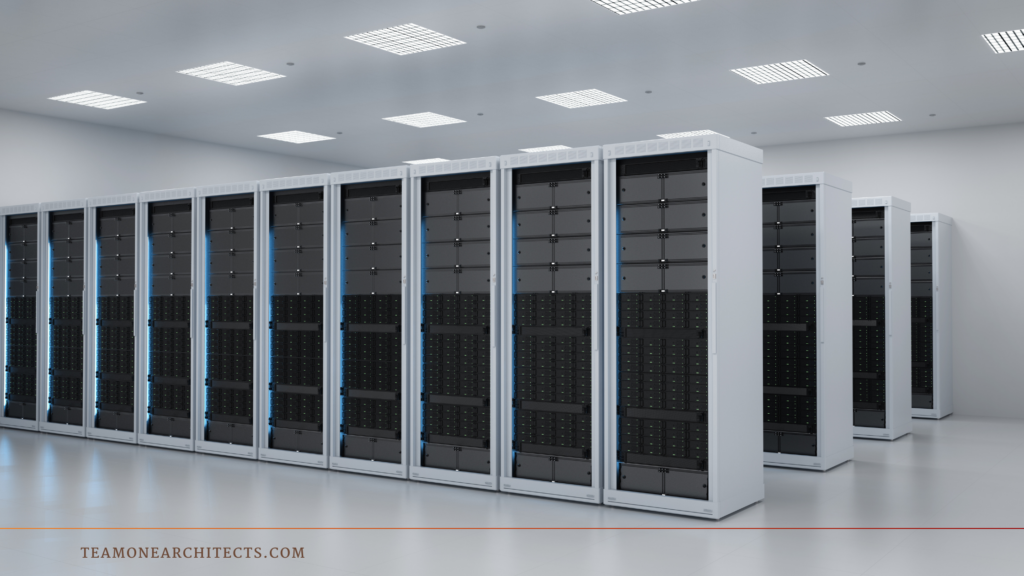
AI-optimized high-density rack configurations, illustrating the computational intensity driving architectural evolution.
Towards Sustainable Digital Infrastructure
Budget 2026 catalyses a new era for Indian data centers, compelling architecture to balance performance, efficiency, and environmental responsibility. Forward-looking designs—modular, intelligently cooled, and renewably powered—will define competitive, resilient facilities supporting India’s digital leadership.
With extensive experience delivering high-performance, energy-efficient projects at scale—including sustainable tech workplaces and R&D-aligned environments—Team One Architects is well-positioned to partner with international and domestic corporations navigating India’s data center boom. Our approach integrates global best practices with local policy advantages to achieve net-zero-aligned outcomes. Explore insights via the India Answers Hub, review our portfolio for relevant case studies, or connect to discuss your infrastructure needs.
References
- Press Information Bureau (PIB), Government of India, Budget 2026–27 Highlights (February 2026).
- Mordor Intelligence, India Data Center Market Report (January 2026).
- DCNT Global & Economic Times analyses on capacity and hubs (February 2026).